YouTube Synchronization Royalties Explained: How Direct Publishing Income Works
Learn how YouTube Synchronization royalties really work, why they’re classified as direct publishing income, and how songwriters, publishers, and CMOs can collect platform-specific YouTube synchronization royalties at scale.
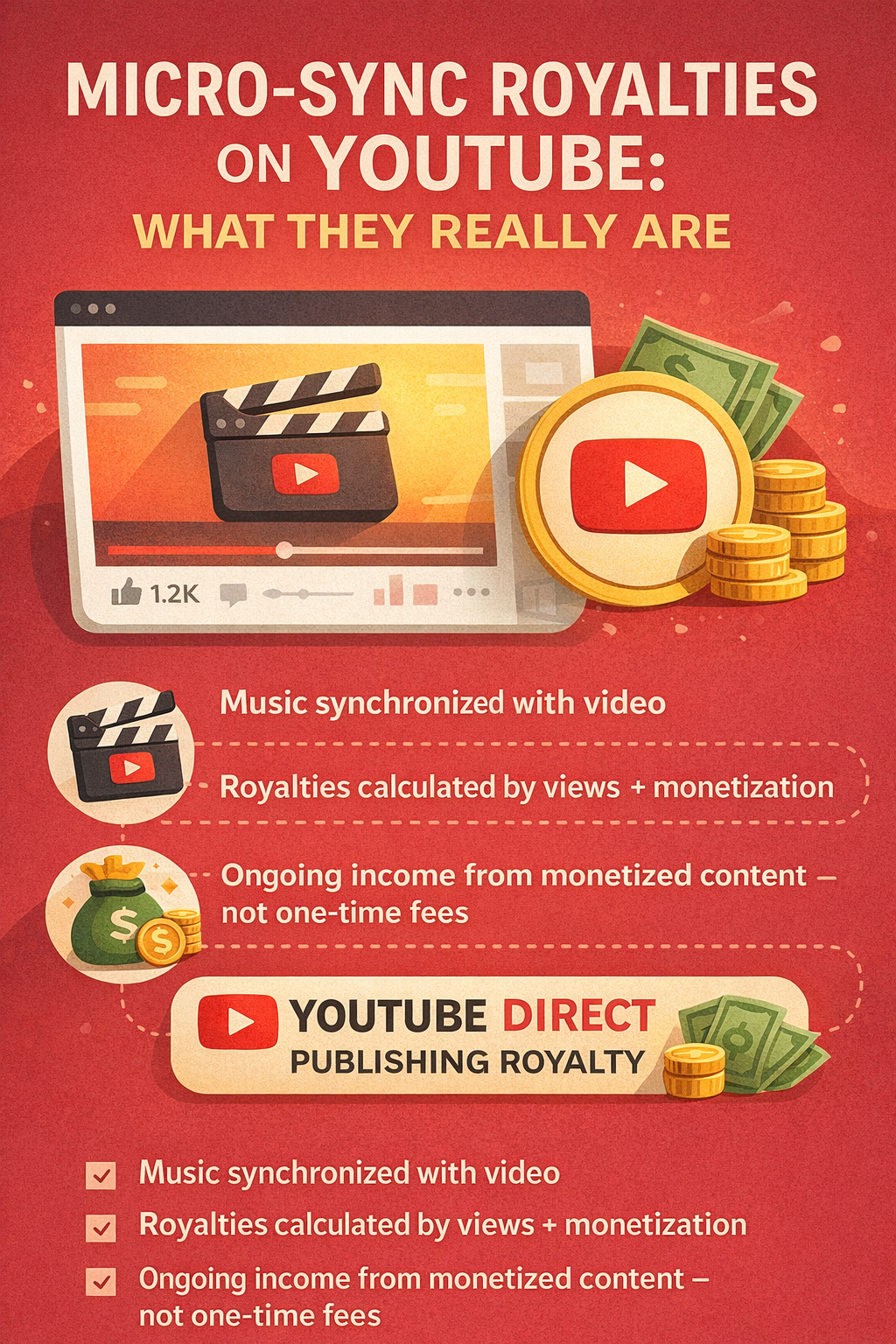
Micro-Sync Royalties on YouTube: What They Really Are
When people talk about “sync” income, they’re usually referring to music being placed in films, TV shows, ads, or games. In simple terms, sync happens when music is paired with visual content.
On platforms like YouTube, that same concept exists - but it works a little differently.
Micro-Syncs in the YouTube Era
Every time music is used in a YouTube video, that use requires permission from the copyright owner. Instead of negotiating individual licenses for each upload, YouTube operates under direct agreements with publishers and administrators that allow the platform to host and monetize massive volumes of videos containing music.
Inside YouTube’s systems, this usage is commonly labeled as a “YouTube Synchronization” royalty.
But despite the name, it’s not a traditional sync license in the film-and-TV sense.
What This Royalty Actually Represents
The royalty YouTube pays for this type of usage is best understood as a direct digital publishing royalty.
It’s bundled and platform-specific, meaning:
It covers music being synchronized to video
It accounts for digital reproduction and streaming
It is calculated and paid directly by the platform under its publishing agreements
Because of this, it doesn’t behave like a classic mechanical royalty, and it isn’t a one-time sync fee either. Instead, it sits somewhere in between.
In practical terms, it’s a hybrid royalty - combining elements of sync and reproduction into a single digital payout that scales with views and monetization.
For simplicity, we refer to this as a YouTube direct publishing royalty.
Why This Matters for Songwriters and Publishers
YouTube is one of the largest music-using platforms in the world. Millions of monetized videos use music every day - from long-form content to Shorts.
When your music is used in these videos, revenue can be generated in several ways, including:
Traditional performance royalties (handled by PROs and CMOs)
Platform-specific direct publishing royalties paid by YouTube
Other territory-dependent digital uses
The challenge is that this direct YouTube publishing income is often misunderstood or overlooked, which can lead to missed revenue.
How CHOIS MUSIC Helps Collect This
At CHOIS MUSIC, we help identify, manage, and collect YouTube direct publishing royalties on behalf of:
Songwriters
Music publishers
Collection Management Organizations (CMOs)
Our role is to ensure that:
Works are correctly registered and matched inside YouTube’s systems
Publishing rights are properly represented at the platform level
Royalties labeled as “YouTube Synchronization” inside CMS are captured and paid
A Growing Revenue Stream You Can’t Ignore
As short-form video and creator content continue to dominate online media, this type of YouTube publishing income is becoming increasingly important.
It may not always look like a traditional sync or mechanical royalty on paper - but it’s very real money, and it scales with usage.
If your catalog is being used on YouTube and properly monetized, these royalties may already be accruing.
The key is making sure they’re actually being collected.
If you’d like to learn how CHOIS MUSIC can help manage and collect YouTube direct publishing royalties for your catalog, feel free to reach out.